
Uganda: Four Environmental Defenders Arbitrarily Arrested and Detained
The Observatory for the Protection of Human Rights Defenders, a partnership of the International Federation for Human Rights (FIDH) and the World Organisation Against Torture (OMCT), has been informed about the arbitrary arrest and detention of four young environmental human rights defenders, Mr Ssembalirwa Aniwaly, Mr Mugoya Hassan, Mr Okanya Ivan and Mr Ariong Arone Patrick, members of the youth-led movement Rooted in Resistance, which advocates for greater accountability regarding Uganda’s natural resources and for the protection of the environment.
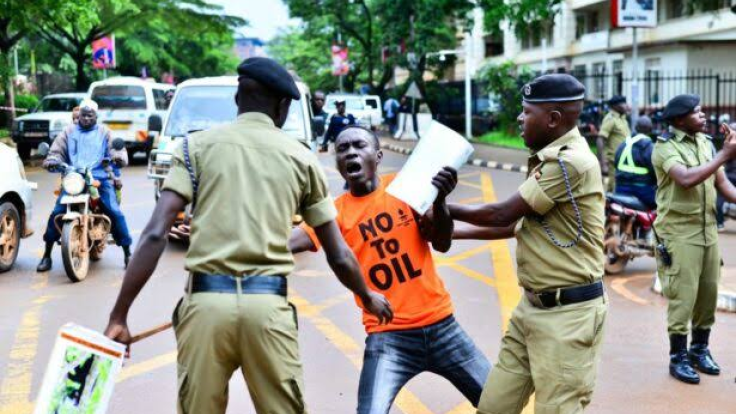
The Observatory for the Protection of Human Rights Defenders, a partnership of the International Federation for Human Rights (FIDH) and the World Organisation Against Torture (OMCT), has been informed about the arbitrary arrest and detention of four young environmental human rights defenders, Mr Ssembalirwa Aniwaly, Mr Mugoya Hassan, Mr Okanya Ivan and Mr Ariong Arone Patrick, members of the youth-led movement Rooted in Resistance, which advocates for greater accountability regarding Uganda’s natural resources and for the protection of the environment.
On 10 August 2026 at around 9:00 a.m., the four human rights defenders were peacefully marching along King George Way in central Kampala towards Parliament, where they intended to submit a petition calling for a new economic model centred on economic freedom and broad-based prosperity for Ugandans from the country’s oil resources. They were reportedly wearing orange T-shirts bearing the words "Rooted in Resistance" and carrying placards stating, among others, "Prioritize other sectors of the economy", "Oil is Temporary, Nature is Permanent" and "Oil Today, Problems Tomorrow".
Ugandan police intercepted and arrested the four activists during the peaceful march, after which they were taken to Central Police Station in Kampala. They were subsequently brought before the Buganda Road Chief Magistrate’s Court in Kampala, before Grade One Magistrate Rophine Achayo, where they pleaded not guilty to charges of « public/common nuisance for allegedly disrupting traffic and creating road hazards » under the Road Act, Cap. 346 . On 10 August 2026, they were remanded to Luzira Maximum Security Prison, where they remain detained. Their next court hearing is scheduled for 28 August 2026.
The arrests took place in the context of ongoing mobilisation by Rooted in Resistance concerning Uganda’s oil sector and the environmental and social consequences of oil-related projects, including the East African Crude Oil Pipeline (EACOP). The movement, formerly known as Students Against EACOP Uganda, has repeatedly organised peaceful protests and petitions concerning the project and the use of Uganda’s natural resources.
The Observatory recalls that these incidents illustrate a persistent pattern of harassment targeting those opposing EACOP and defending environmental and human rights. Environmental rights defenders in Uganda have, in recent years, repeatedly faced arbitrary arrests, judicial harassment, and torture. For example, on 9 August 2024, 47 students were arrested in Kampala during a peaceful protest against the EACOP project. Between May and June 2024, environmental activists like Adriko Sostein, Julius Tumwiine, and Stephen Kwikiriza were arrested and arbitrarily detained, as well as Bob Barigye, Noah Katiiti, Newton Mwesigwa, Julius Byaruhanga, Desire Ndyamwesigwa, Raymond Binntukwanga, and Jealousy Mugisha Mulimbwa. In April 2025, 11 environmental defenders, known as #KCB11 were arbitrarily arrested and detained following a peaceful protest denouncing the Kenyan Commercial Bank’s decision to fund EACOP. In October 2024, the United Nations Special Rapporteur on Human Rights Defenders sent a letter to the Ugandan government, raising concern about the increasing harassment of activists opposing the EACOP, particularly Students for Global Democracy. More recently, in April 2026, eight young environmental defenders affiliated with Rooted in Resistance were convicted and sentenced to 11 months’ imprisonment in connection with their participation in a peaceful protest against EACOP. These cases have occurred against a broader backdrop of increasing restrictions on civic space in Uganda, including in the context of the 2026 elections. Human rights defenders and other civic actors have increasingly faced arrests, judicial proceedings and other forms of intimidation in connection with their legitimate activities. In this context, the use of criminal proceedings and custodial sentences against environmental defenders opposing EACOP further raises concerns about the shrinking space for civic participation in Uganda.
The Observatory also recalls that, as a State Party to the International Covenant on Civil and Political Rights (ICCPR), Uganda must respect and ensure the rights to freedom of expression and peaceful assembly (Articles 19 and 21), as well as the right to a fair trial (Article 14).
The Observatory is also worried that this may have a chilling effect on civil society actors advocating for environmental protection and responsible management of Uganda’s natural resources. The Observatory urges the Ugandan authorities to immediately and unconditionally release the environmental defenders , drop all charges brought against them and guarantee in all circumstances that they are able to peacefully express their opinion and participate in public debate without fear of reprisals or judicial harassment.
Comments
0 commentsComments are moderated before publication. Respectful, relevant discussion is welcome.
Neuen Kommentar hinzuf??gen